Your AI Reads Your Other Posts — That's Why It Writes Better Ones
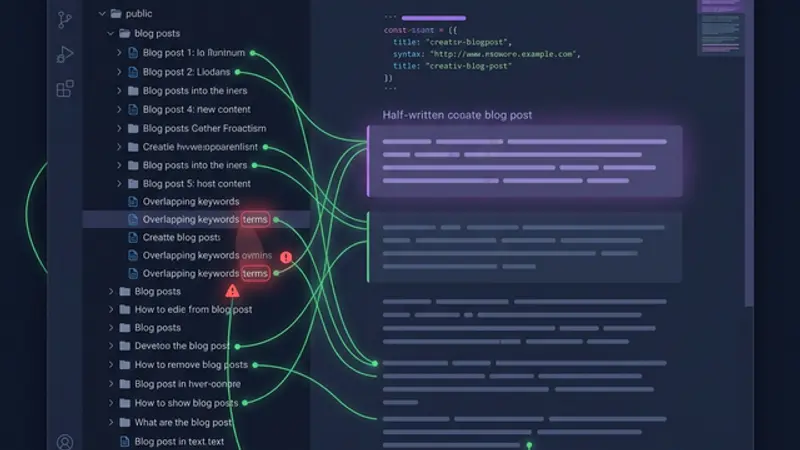
Keyword cannibalization happens when your own posts compete against each other in search. An AI that can read your entire content library detects keyword overlap, shifts angles automatically, and builds internal links — turning blind content creation into strategic publishing.
The Blog Post That Knows About All the Others
AI blog writing tools that have access to your entire content library don't just write faster — they write strategically. They read your existing posts, understand your keyword landscape, and actively avoid competing with your own content. The result isn't just a blog post. It's a blog post that makes every other post on your site stronger.
Most people write blog posts with AI by opening ChatGPT and typing "write a blog post about X." The AI has no idea what you've already written. It doesn't know your voice. It doesn't know your keywords. It doesn't know that you published a nearly identical article three weeks ago.
The result? You compete with yourself — and Google makes you both lose.
What Keyword Cannibalization Actually Looks Like
Keyword cannibalization happens when multiple pages on your site target the same search terms, forcing Google to choose between them. Instead of one strong page ranking well, you get two weak pages splitting authority. It's one of the most common — and most invisible — SEO mistakes.
Here's a real example from building this site:
| Post 1 | Post 2 | The Problem |
|---|---|---|
| "The IDE Advantage Isn't About Code" | "From Bug to Blog in Minutes" | Both target "AI IDE" + "productivity" |
| Broad thesis about context | Specific walkthrough of a workflow | Google can't tell which to rank |
When we wrote the second post, the AI could see the first one. It knew the keyword landscape was already covered. So instead of writing another "AI in your IDE" angle, it shifted to a specific workflow story — turning a bug into a blog post. Same topic area, completely different search intent.
That's not just writing. That's SEO strategy happening automatically because the AI can read your other files.
How IDE Context Changes Blog Writing
When an AI writes a blog post inside an IDE with access to your entire content directory, it has capabilities that no chat-based AI can match:
1. It Reads Every Existing Post
Before writing a single word, the AI can scan all your .mdx files. It knows:
- Every title and description you've used
- Every keyword and tag across your site
- Every cluster your content belongs to
- Every internal link already in place
This isn't a feature you request. It's automatic. The AI reads your content directory the same way it reads your codebase — because to it, blog posts are code.
2. It Avoids Your Own Keywords
When the AI identifies that your target keyword overlaps with an existing post, it has three strategies:
| Strategy | When to Use | Example |
|---|---|---|
| Angle shift | Same topic, different intent | "AI IDE" → focus on blog writing specifically, not code |
| Long-tail pivot | Existing post covers the broad term | "AI productivity" → "AI blog writing SEO" (more specific) |
| Complementary framing | Both posts should exist | Make Post A the pillar, Post B the supporting spoke |
A chat-based AI can't do any of this because it doesn't know your other content exists.
3. It Understands Your Cluster Map
This site uses an 8-cluster content architecture:
- Interactive UX
- Interactive Components
- Web Performance
- AI-Powered Dev Tools
- AI-Assisted Design
- Content Strategy ← this post
- AI Productivity
- Web Architecture
The AI knows which cluster each post belongs to. When writing a new post, it checks: does this cluster need more content? Is there a pillar post? How does this piece connect to the others?
This post belongs to Content Strategy — a cluster that needs more supporting content. The AI didn't assign it there randomly. It looked at the cluster map and saw the gap.
4. It Weaves Internal Links Naturally
Every blog post should link to related content on your site. Chat AI can't do this — it doesn't know what else you've published. An IDE-based AI does it automatically:
- It links to the IDE advantage post because it's topically related
- It links to the creative process post because it discusses AI workflow
- It links to stop prompting, start planning because the planning workflow applies to content too
- It links to the AI productivity pillar because this supports that cluster
These aren't afterthoughts. The AI reads the other posts, understands the relationships, and weaves links into the narrative where they fit naturally. Hub-and-spoke linking, built in from the first draft.
The SEO Audit Loop
Here's where IDE context becomes a genuine competitive advantage. This site has an SEO audit dashboard that runs automated checks on every post:
| Check | What It Catches |
|---|---|
| Title length | Too short (weak) or too long (truncated in search) |
| Description length | Missing or poorly optimized meta descriptions |
| Image alt text | Missing imageAlt or lazy alt text that duplicates the title |
| Internal links | Posts with zero links to other content |
| Cluster assignment | Uncategorized posts or cluster imbalances |
| Schema validity | JSON-LD structured data for rich results |
| Word count | Thin content that won't rank |
The AI writes the post. The dashboard audits it. The AI fixes the issues. The feedback loop is closed — and it's happening inside the same environment, with full context.
In a chat-based workflow, you'd write the post in ChatGPT, paste it into your CMS, run an SEO audit in a separate tool, copy the issues back to ChatGPT, ask for fixes, and paste the result back. Every step loses context. Every transition introduces errors.
What Chat AI Gets Wrong About Blog Writing
Chat-based AI writes each post in isolation. It's starting from zero every time. The consequences are predictable:
- Duplicate angles — it writes the same thesis you published last week
- Keyword overlap — it targets terms you've already covered
- Missing links — it can't link to your other content because it doesn't know it exists
- Tone drift — it doesn't know your voice because it's never read your previous work
- Cluster blindness — it assigns generic categories instead of fitting into your architecture
An AI with IDE context has the opposite problem: it sometimes knows too much. It references posts you haven't published yet. It links to drafts. It adjusts its keyword strategy based on scheduled content that hasn't gone live.
That's a much better problem to have.
The Meta Example: This Post
This article is the perfect case study because it was written by an AI that did exactly what it describes:
- Read all 22 existing posts before starting
- Identified keyword overlap with "the IDE advantage" post — shifted to blog writing angle
- Checked the cluster map — Content Strategy needs more supporting posts
- Wove internal links to 4 related articles naturally
- Set proper frontmatter — SEO-optimized title, description, alt text, tags
- Avoided cannibalization — this post targets "keyword cannibalization," not "AI IDE productivity"
None of this was prompted. The AI did it because it could see the context. That's the whole thesis, demonstrated in real-time.
The Practical Takeaway
If you're writing blog content with AI and you're doing it through a chat interface, you're leaving the most powerful SEO advantage on the table. It's not about writing speed — it's about writing awareness.
| Chat AI | IDE AI | |
|---|---|---|
| Speed | Fast | Fast |
| Context | Zero — starts from scratch | Full — reads all your content |
| Cannibalization risk | High — doesn't know your other posts | Low — actively avoids overlap |
| Internal linking | None — doesn't know your site | Automatic — weaves links naturally |
| Cluster strategy | None — writes in isolation | Built-in — fits posts into architecture |
| SEO audit loop | Separate tool, manual copy-paste | Same environment, closed feedback loop |
The AI that reads your other posts writes better ones. Not because it's smarter — because it's not blind.
This post is part of our Content Strategy series. Related: The IDE Advantage Isn't About Code and Stop Prompting, Start Planning.