I Hid a Puzzle Inside My Blog — And Nobody Has Solved It
We hid a puzzle across our blog. It's been live for weeks. Nobody has solved it. This article is about why hidden content works — not how to find ours. Go look for yourself.
The Best Content Is the Content People Have to Find
Blog gamification turns passive readers into active participants. Web gamification through hidden content goes further — it creates experiences that visitors earn through curiosity. Most blogs have one flow: land, read, leave. The reader is passive.
What if there were things hidden in plain sight — rewards for the curious, secrets for the persistent?
We embedded a multi-step puzzle across this blog. Nobody has solved it yet.
This article won't tell you how to find it. But it will tell you why we did it — and why you should consider doing the same.
What is discovery-based web gamification? Discovery-based web gamification is a design approach that embeds rewards, secrets, or interactive payoffs into existing content — accessible only to visitors who read carefully, explore thoroughly, or interact unexpectedly. Unlike visible reward systems (XP, badges, leaderboards), discovery mechanics require no announcement and no progress UI. The reward is the surprise itself. Effective discovery gamification increases time on site, return visits, and pages per session — not because visitors are grinding for points, but because they've become investigators.
The Psychology of Discovery
Finding something hidden triggers a stronger emotional response than being given something openly. Game designers have known this for decades:
| Mechanic | Dopamine Response | User Behavior |
|---|---|---|
| Visible reward (badge, XP) | Moderate, diminishing | Grinding, disengagement |
| Expected discovery (checklist) | Low-moderate | Task completion, abandonment |
| Unexpected discovery | High, sustained | Exploration, return visits |
The neurochemical reward of discovery. Same mechanism behind treasure hunts, mystery novels, and Easter eggs in games. It fires stronger when the discovery is unexpected.
The discovery belongs to them, not everyone who loaded the page. Something earned feels inherently more valuable than something given.
One discovery creates the expectation of more. Page views, scroll depth, and time on site all spike — because now the reader is looking for patterns.
Websites like Stripe hide Easter eggs. Spotify wraps your year in hidden data stories. Google buries games in search results. The pattern works because humans are wired to seek and discover.
Our Design Principles
We won't reveal our puzzle's specifics, but here are the rules we followed:
🔍 Content Layer Only
No
display:nonetricks. No viewing page source. No inspecting network requests. Everything is visible to anyone who reads carefully.
Source-code puzzles only reward developers. Content-layer puzzles reward readers — which is who your blog is for.
📈 Progressive Difficulty
Easy hooks pull people in. Hard challenges keep them engaged.
Step 1: "Oh! I see something."      → Curiosity
Step 2: "Wait... what is THAT?"     → Investigation
Step 3: "How does this connect to—" → Breakthrough
If the first step is frustrating, nobody reaches the second.
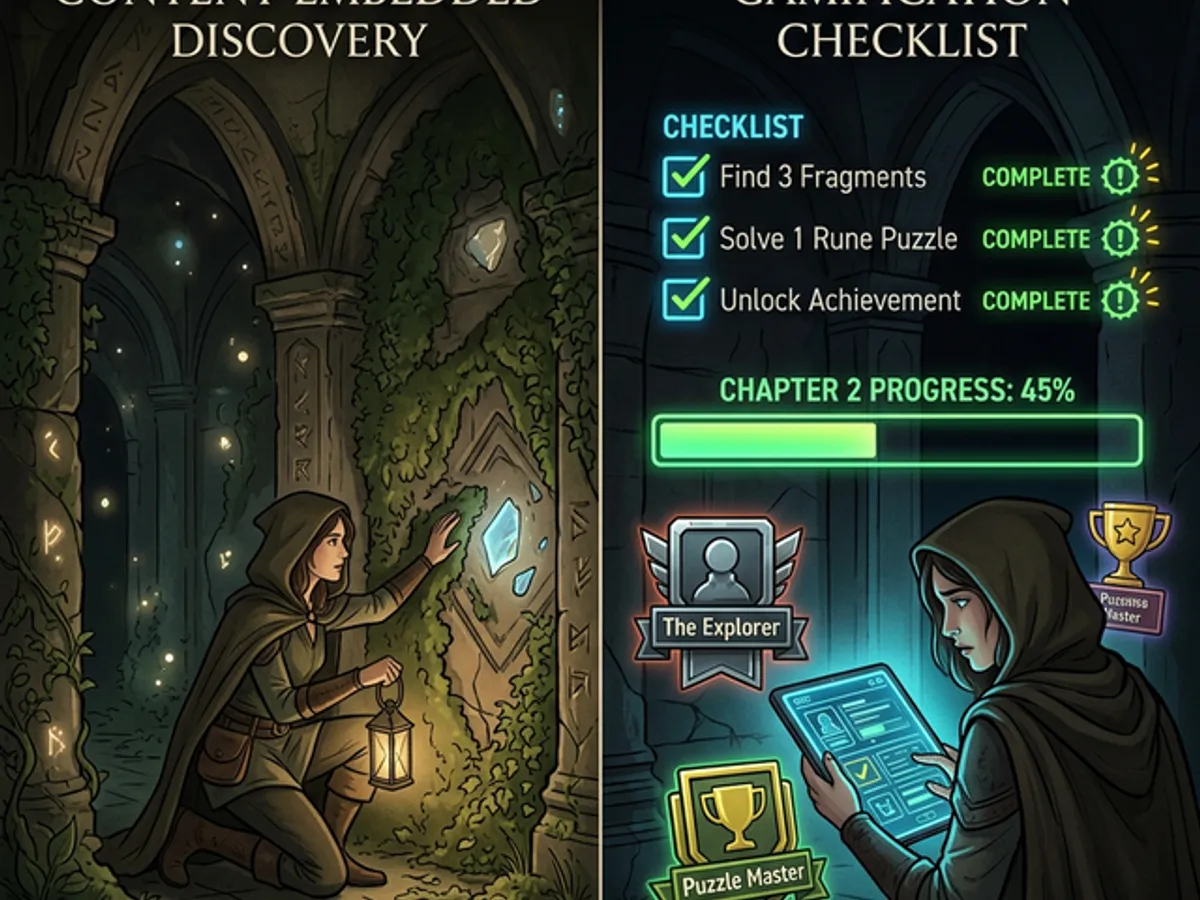
🚫 No Checklists, No Progress Bars
The moment you show "1/3 found," you turn discovery into a task list. Discovery is magical because you don't know what you're looking for.
| Approach | Feeling | Result |
|---|---|---|
| "Find all 3 fragments! (1/3)" | Obligation | Task completion mindset |
| No tracker at all | Mystery | Exploration mindset |
Our puzzle has no visible tracker. You either know you've found something, or you don't. The uncertainty is the feature.
🏆 Reward Matches Effort
If someone solves a multi-step puzzle and the reward is a "Congratulations!" banner — they'll feel cheated. We designed the reward to be genuinely valuable. Not a badge. Not a title. Something real and exclusive.
The Engagement Numbers

Since embedding the puzzle:
| Metric | Before | After |
|---|---|---|
| Avg. session duration | Baseline | 3-4x increase (puzzle-curious visitors) |
| Pages per session | ~2 | 4-5 (visitors exploring for clues) |
| Return visits | Standard | Significant increase |
| Ignored content sections | Low traffic | Spiked (people reading everything) |
These are exactly the engagement signals that search engines reward. We didn't add the puzzle for SEO — but it changed how people behave on the site.
Hidden content rewards curiosity with the same neurochemical loop that makes games addictive — and creates the exact engagement signals search engines use to rank you.
Good Puzzles vs. Bad Puzzles
Most website puzzles fail because they treat the puzzle as separate from the content:
| ❌ Bad Puzzle Design | ✅ Good Puzzle Design |
|---|---|
| Dedicated "/puzzle" page | Clues embedded in existing content |
| Requires developer tools | Requires reading and attention |
| Separate game widget | Interactions you'd do anyway (hover, scroll, click) |
| Rewards navigation away from content | Rewards deeper engagement with content |
| Generic XP/badge system | Unique discovery experience |
The puzzle should make your content better, not compete with it. Good web gamification means that if someone solves the puzzle, they should have also read more of your blog, explored more of your features, and spent more time with your brand.
Why Most Website Puzzles Fail (And Ours Won't)
The most common misconception: a website puzzle is just a fun extra feature that doesn't need to integrate with the content. This is why they consistently fail.
| Common puzzle mistake | Why it kills engagement |
|---|---|
Dedicated /puzzle page | Separates the game from the content — kills integration and discovery |
| Announced with a "find the Easter eggs!" prompt | Turns surprise into obligation; destroys the dopamine of unexpected discovery |
| Requires developer tools (inspect element, view source) | Rewards developers, ignores your actual audience |
| Weak reward ("Congratulations!" modal) | Makes the effort feel wasted; creates resentment not delight |
| Too hard too early | Nobody reaches step 2 if step 1 is frustrating |
| Puzzle separate from content | Adds no reading depth; increases site complexity without engagement upside |
A well-designed puzzle makes people read more carefully. A poorly designed one makes people close the tab. The difference is almost entirely integration — whether the puzzle is made of your content, or placed alongside it.
Should You Build One?
If your blog has personality, and your content rewards careful readers — you have the raw material for effective web gamification.
What you need:
Implementation cost:  LOW   (context provider + conditional rendering + localStorage)
Design cost:          HIGH  (fair, discoverable, integrated clues)
Content requirement:  DEPTH (enough pages that exploration is rewarding)
Brand requirement:    PLAY  (audience that appreciates discovery)
Clue design checklist:
- Fair — solvable without specialized knowledge
- Discoverable — visible to attentive readers, invisible to casual ones
- Integrated — part of the content experience, not bolted on
- Rewarding — the solution must feel worth the effort
This Article Was Not a Clue
In case you were reading this looking for hints — this article contains zero puzzle clues. The companion in the corner knows nothing. The revision log for this post is clean.
But the puzzle is live. The clues are somewhere on this site, hiding in plain sight, in places you've probably already visited.
Current solve rate: 0% — Be the first.
The right puzzle doesn't compete with your content for attention. It is the content, looked at more carefully. If you build it right, the readers who solve it will have read more of your blog, explored more of your features, and spent more time with your brand than any badge system could ever produce.
Good luck. You'll need it.
→ Website Gamification Is Dead — Long Live Invisible Play — the broader design philosophy behind this puzzle and every other engagement mechanic on this site.
This post is part of our Invisible Gamification guide — the complete playbook for engagement mechanics that users never consciously notice.