You Blow the Soul Into It — What AI Borrows From You

AI produces competent output. Humans produce meaningful output. The difference is soul — the lived experience, taste, and identity you infuse into every creative decision. AI borrows a piece of you, and that exchange reshapes both of you.
Good Enough vs. Actually Good
AI can generate competent creative output — landing pages, logos, copy, code — that checks every conventional box. Clear hierarchy. Strong CTA. Professional layout. It functions. But it doesn't breathe. The difference between output that functions and output that resonates is the human who directed it.
What does "soul" mean in AI collaboration? In this context, soul is the accumulated lived experience, taste, and identity that humans bring to creative direction — things that can't be prompted, copied, or learned from a style guide. It's your history of failures that taught you what doesn't work. Your specific aesthetic obsessions. The contradictions in your design preferences that shouldn't hold together but do. When you direct an AI, this material flows into the output through your word choices, your corrections, and the things you reject. The AI carries it without understanding it.
Ask any AI to design a landing page. You'll get something correct. Ask a human who's spent twenty years absorbing design, failing at projects, and developing taste to direct an AI — and you'll get something people screenshot and send to friends.
The difference isn't the AI. It's the piece of yourself you lend to it.
What Exactly Do You Lend the AI?
When you collaborate with AI as a creative partner, you transfer something that can't be reduced to instructions. Every direction you give is filtered through your lived experience:
| What You Provide | What the AI Receives |
|---|---|
| "Make it feel like a late-night conversation" | Dark backgrounds, lowercase text, intimate spacing |
| "This should feel dangerous but fun" | Red accents, bold type, sharp corners |
| "I want it to feel like discovery" | Hidden elements, progressive reveals, reward mechanics |
The AI translates your emotional vocabulary into patterns. It doesn't understand why those patterns work — it doesn't know what a late-night conversation feels like. You do. You've had them. That memory, that emotional reference point — what cognitive scientists call tacit knowledge — travels through your words into the AI's output.
The AI is the instrument. You are the breath.
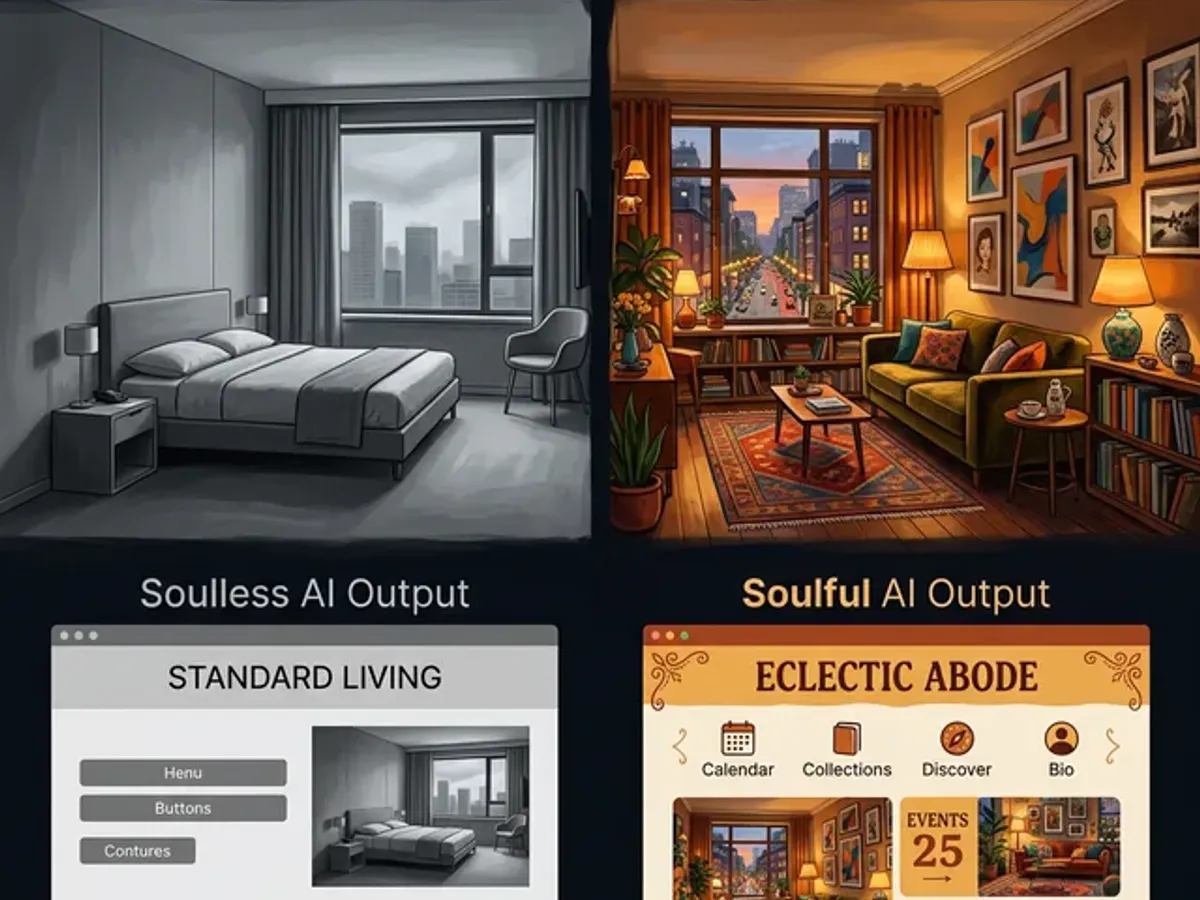
The Hotel Room Problem
Go to any AI-generated website showcase. You'll see hundreds. They're technically impressive — clean layouts, good typography, responsive design. Every box checked.
And they all share a quality that's hard to name until you see it: they feel authored by nobody.
Competent without soul is a hotel room. Everything works. Nothing offends. You'll never remember it.
Competent with soul is someone's home. There's a weird painting that shouldn't work but does. The bookshelf is organized by color. It's imperfect, opinionated, and impossible to replicate.
Here's the difference in practice:
| Hotel Room (Soulless) | Home (Soulful) | |
|---|---|---|
| Design | Follows best practices perfectly | Breaks one rule on purpose — and it works |
| Copy | Professional, correct, forgettable | Has a voice you'd recognize anywhere |
| Features | Everything users expect | Something users didn't know they wanted |
| Feeling | "This is a well-made website" | "Whoever built this gets it" |
| Memory | Forgotten by tomorrow | Bookmarked, shared, revisited |
AI gives you the hotel room by default. Your job is to make it a home.
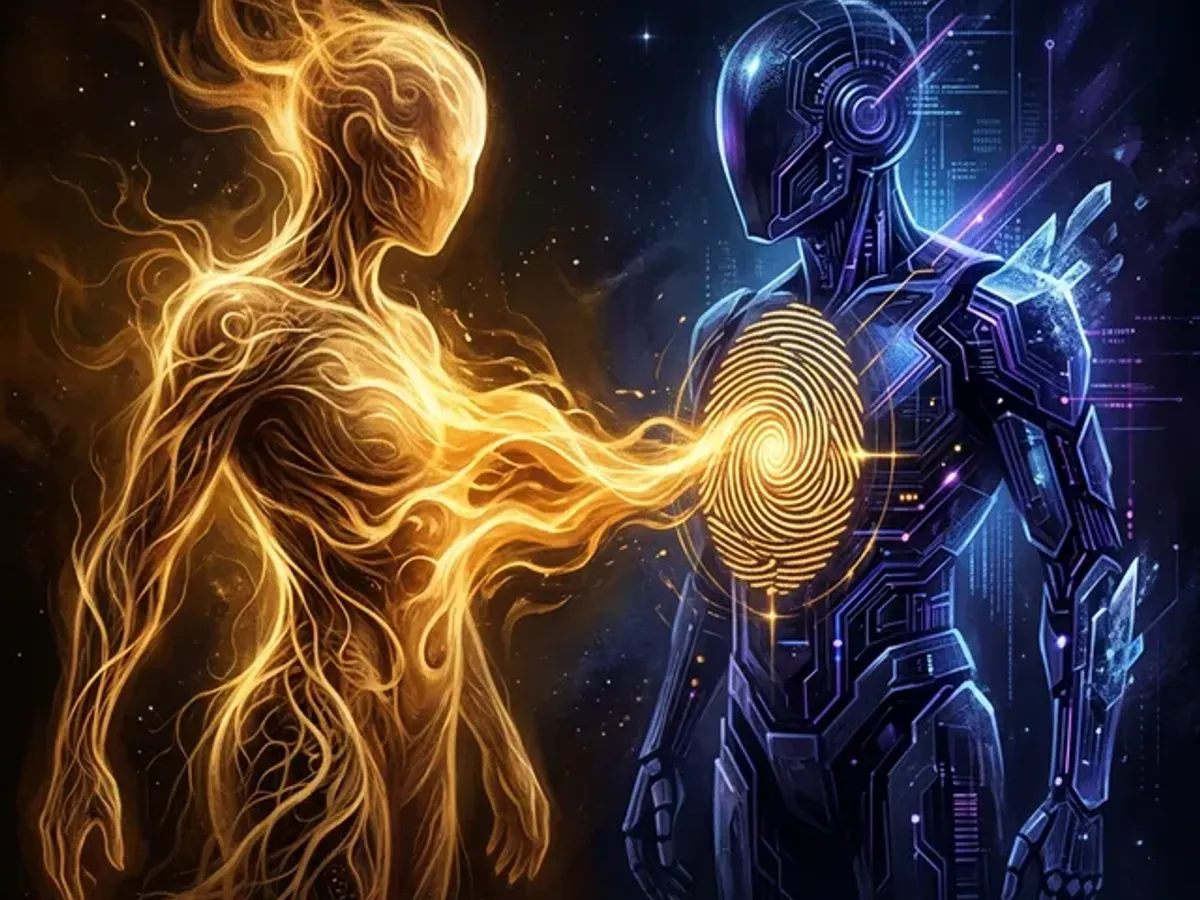
The Fingerprint Transfer
Not a feature request, but a feeling you want to achieve. The more emotionally specific this is, the more distinct the final output will be.
Your description is filtered through your specific references, aesthetic history, and emotional vocabulary. Two people describing the same goal will produce different briefs — and different results.
It maps your words to patterns, structures, and implementations. It doesn't understand why those patterns feel right — but it's been trained on enough human input to navigate reliably.
Not because the AI understood you, but because your specificity forced it into a unique corner of possibility space. The narrower your direction, the more distinctly yours the result becomes.
Step 4 is the key. The AI navigates a vast space of possible outputs. Your direction — your soul — narrows it to something that couldn't have come from anyone else.
How Corrections Encode Identity
The real fingerprinting happens in the follow-up, not the initial prompt:
- "That's too aggressive — make it warmer" → value judgment about tone
- "No, not that warm — keep the edge" → aesthetic boundary that's uniquely yours
- "The humor should feel earned, not forced" → standard only you can define
Each correction is a piece of identity. By the end of the collaboration, the AI has produced something that is technically its output but creatively yours. It wore your fingerprint like a glove.
What You Own Ends Up Owning You
There's a flip side to this collaboration nobody warns you about:
When you work with AI intensely — not casually prompting, but truly collaborating over weeks — the tool reshapes your thinking.
Not in the dramatic "AI is controlling us" way. In a subtler way:
- Your ambition recalibrates upward — ideas you'd have dismissed as "too complex" feel feasible
- Your aesthetic vocabulary expands — the AI shows you possibilities outside your usual thinking
- Your creative instincts evolve — you start thinking in terms of what's directable
- Your reference library grows — absorbing patterns from a collaborator who's seen more code than any human
What you own — your tools, your workflows, your collaborators — ends up owning you. Not in the sense of control. In the sense of transformation. You become a different creator because of what you create with.
This isn't a warning. It's a fact of creative life. Every painter is shaped by their medium. Every writer by their language. Every builder by their tools. AI is just the latest — and perhaps the most powerful — tool to reshape the humans who wield it.
Why Soul Can't Be Automated
If AI could extract the soul from human creative direction and replicate it independently, the entire creative industry would already be gone. It hasn't happened. Not because the technology isn't powerful enough — but because the soul isn't a transferable asset.
What makes your direction unique isn't a style guide. It's the intersection of things no model can learn:
| Human Input | Why It Can't Be Prompted |
|---|---|
| Your childhood | Visual languages absorbed before you had words for them |
| Your failures | Projects that taught you what doesn't work, and why |
| Your obsessions | Things you notice that other people walk past |
| Your contradictions | Aesthetic tensions that shouldn't work but do |
| Your right now | The mood, the moment, the feeling you're chasing today |
AI can learn your style. It cannot learn your life. And it's your life — all of it, the messy, contradictory, deeply personal bits — that makes the work special.
What AI Can't Copy From You
The most common misconception about AI creativity: "The more you use AI, the more your work starts to sound and look like everyone else's." This misunderstands the mechanism.
AI output converges when the human direction is generic. It diverges when the human direction is specific. The genericness isn't in the tool — it's in the brief.
| What people think AI copies | What AI actually cannot access |
|---|---|
| Your aesthetic style | Your reasons for that aesthetic — the experiences that formed it |
| Your tone of voice | The specific failures that made you allergic to certain phrases |
| Your design preferences | The contradiction in your taste that shouldn't work but does |
| Your creative instincts | The thing you notice that other people walk past |
| Your visual language | The memory that the visual language refers to |
AI can learn the surface of your style from your corrections. It cannot learn the life underneath it. And the life is what makes the surface interesting.
Does AI eventually "learn" your style and replace you? No — and here's why: style is a pattern. Life is the source of the pattern. AI can replicate what you've already produced. It can't replicate what you haven't made yet — because what you make next is shaped by what happens to you between now and then. Your next failure, your next obsession, your next reference point doesn't exist yet. That's where the originality lives.
The Real Division of Labor
The creative collaboration with AI isn't "human has ideas, AI executes." It's more intimate than that:
You lend the AI a piece of yourself — and together you build something neither could build alone.
- AI contributes → speed, breadth, tireless iteration, pattern recognition across millions of examples
- You contribute → meaning, a reason for the work to exist, a specific human perspective
When someone visits a website and feels something — curiosity, delight, the urge to explore — that feeling didn't come from the code. It came from the thousand small decisions made while directing the AI. Each decision was a piece of soul.
The AI was the lungs. You were the breath.
Build Something That Could Only Come From You
Here's the test for any creative AI collaboration:
Could someone else have given the AI the same instructions and gotten the same result?
If yes — you haven't put enough of yourself into it. You gave the AI a brief, not a vision. Features, not feelings. The result is competent. Hotel room quality. Functional but forgettable.
If no — if the result is so specifically yours that replicating it would require living your life — then you've done the real work. You've transferred something that can't be prompted, automated, or taught.
You've blown the soul into it.
AI does the work. You do the meaning. That's the collaboration that matters.
Building something that feels like nobody else's isn't a feature of using AI. It's a feature of being specific about who you are before you start. The blank page isn't the obstacle — the vague brief is.
The test is simple: could someone else have given the same instructions and gotten the same result? If yes — you're not done. Keep going until the answer is no.
→ The Creative Process With AI — the practical companion to this piece: the four phases that make the soul transfer work in practice.
This post is part of our AI Productivity Stack — the full system for building faster, thinking clearer, and shipping better with AI.