What's Behind Our 404 Page — And Why It Needs a Secret

Our 404 page isn't just an error message. We turned it into an experience worth visiting on purpose. Error pages are the most ignored engagement opportunity on the web — here's how to fix that.
The Most Ignored Page on Every Website
Creative 404 error pages transform frustrating dead ends into memorable brand moments — a simple act of gamification that keeps visitors on your site. Every website has a 404 page. Almost none of them deserve the visit.
The standard 404 experience: you click a broken link, see "Page Not Found" in a default font, click "Go Home," and feel a tiny flash of annoyance. The website had a chance to make an impression and wasted it on a dead end.
We decided our 404 page should be the best page on the site.
What is a creative 404 page? A creative 404 page is an error page designed as an intentional brand experience rather than a system message. Instead of displaying "Page Not Found" and a link home, it uses interactive elements, personality, narrative framing, or discovery mechanics to transform a navigation failure into a memorable moment. Effective creative 404s reduce bounce rates from 85–95% to 40–60%, increase time-on-page from 3–5 seconds to 30+ seconds, and generate the kind of brand goodwill that leads visitors to explore the rest of the site rather than abandon it.
What We Actually Built
We can't tell you exactly what's on our 404 page — that would spoil the discovery. But we can say this: it's not a message. It's not a redirect. It's an experience.
We treated the error page as a canvas for something interactive, themed, and self-contained. Something that turns the frustration of a wrong URL into genuine entertainment. Visitors who stumble onto it don't bounce — they stay, they play, they explore.
Want to see it yourself? Type any random path after our domain. We'll wait.
The point isn't what we specifically built — it's that we built anything at all. Most error pages are afterthoughts. Ours was designed with the same attention as a landing page.
Why Error Pages Matter for Engagement
The data on 404 page behavior is clear:
| Metric | Standard 404 | Creative 404 |
|---|---|---|
| Bounce rate | 85-95% | 40-60% |
| Time on page | 3-5 seconds | 30+ seconds |
| Return to site | ~10% | ~50% |
| Social shares | 0 | Significant |
A creative 404 page does three things: prevents the rage-bounce by replacing annoyance with curiosity, creates a brand memory people actually keep, and generates organic sharing — unusual error pages get screenshotted.
A creative 404 doesn't just retain visitors on the error page. It builds enough goodwill that they explore the rest of the site.
Companies like Pixar, GitHub, and Blizzard understand this. Their 404 pages are intentional brand experiences.
Designing Interactive Error Experiences
If you're adding an interactive element to an error page, the most critical design decision is engagement balance. Something too subtle gets ignored. Something too aggressive feels forced. The sweet spot is an experience that invites exploration without demanding it.
| Technique | Purpose |
|---|---|
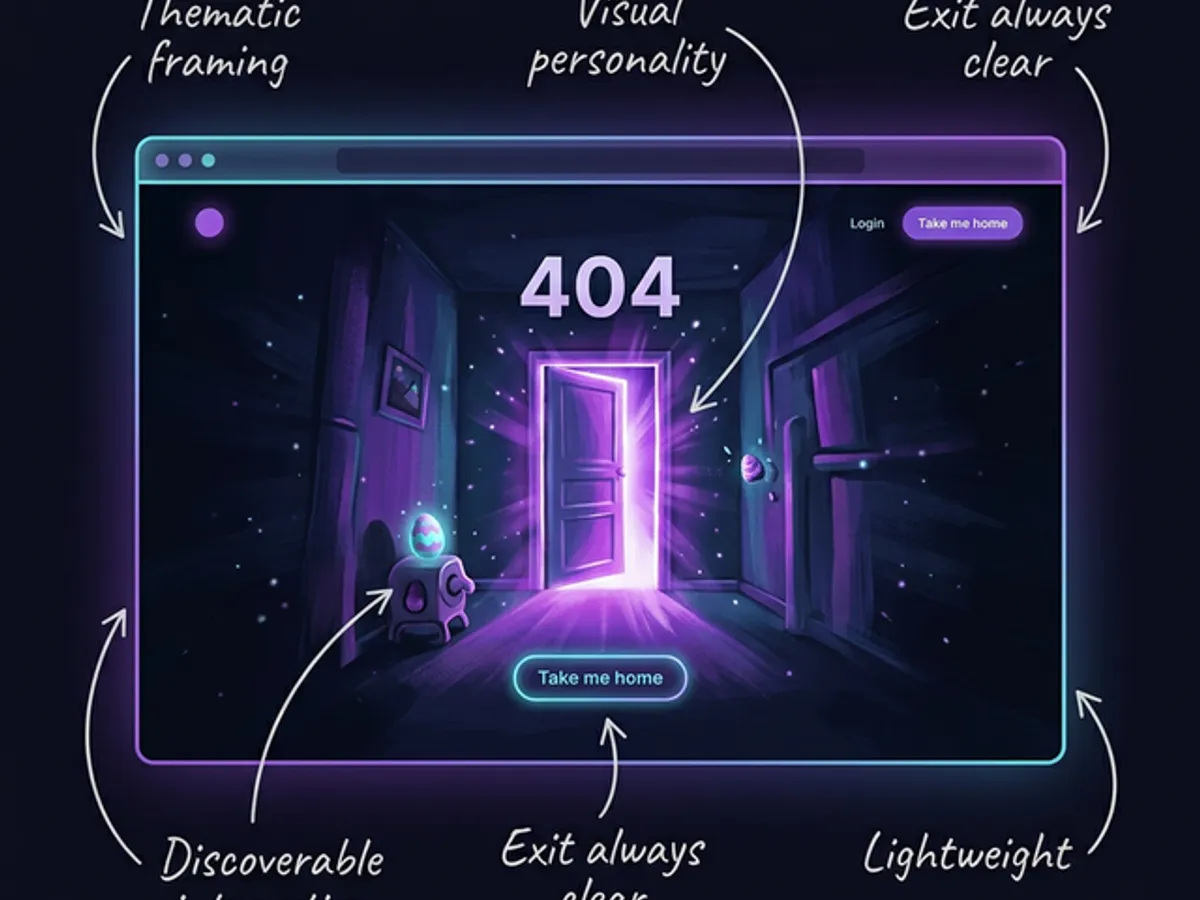
| Thematic framing | Transforms the error into a narrative ("You're lost" → "You've arrived") |
| Visual personality | Custom illustrations, animations, or ASCII art that match your brand |
| Discoverable interactions | Hidden hover effects, clickable elements, or subtle puzzles |
| Visual juice (particles, motion) | Makes every interaction feel impactful |
| Navigation with personality | "Take me home" feels different from a bare link |
The tech stack is simpler than you'd think: CSS animations, a few interactive elements, and a bit of JavaScript. The investment is small — the impression is lasting.
Theming: Making the Error Feel Intentional
The key insight: creative framing turns negatives into positives. "Page not found" is an error. A themed experience is an adventure. Same situation, completely different emotional response.
The most important UX decision: make it optional. Visitors who just want to navigate away should be able to do so immediately. The interactive element is for curious explorers, not captive audiences.
Measuring the Impact
Our 404 page analytics tell an interesting story:
Visitors who land on our 404 frequently continue browsing the blog afterward. The experience doesn't just retain them on the error page — it builds enough goodwill that they explore the rest of the site.
What Most Teams Get Wrong About Error Pages
The most common misconception: a 404 page is a dead end, not a design surface. This is why almost every error page is identical — a <h1>, a vague message, a link home, and nothing else.
| Common mistake | The real cost |
|---|---|
| Treating the 404 as a default system page | 85–95% bounce rate; brand opportunity wasted |
| Adding a creative element but making it unskippable | Frustrates visitors who just want to navigate; defeats the purpose |
| Generic "top posts" list with no personality | Marginally better than a dead end, but still forgettable |
| Interactive element that requires heavy JavaScript | Slow first paint on a page that already broke trust |
| Only designed for desktop | Most broken-link traffic comes from mobile; the experience has to work at every size |
The best creative 404s are lightweight, optional (the exit is always immediate and clear), themed to the site's personality rather than generic error tropes, and designed to invite rather than require interaction.
Building Your Own Creative 404
You don't need a full interactive system. Even simple creative elements dramatically outperform standard error pages:
The key principle: treat the error page as a content page, not a dead end. Budget design time for it. Give it personality. Make visitors tell their friends about it.
The investment doesn't have to be massive. A few hours of creative work on a 404 page pays dividends every time someone mistyped a URL, clicked a dead link, or stumbled onto a path that no longer exists. Those moments are inevitable — the question is whether you let them be dead ends.
A 404 is a dead end. In the right hands, it's the most memorable page on your site. The visitors who find it by accident are the ones who tell people about it on purpose.
→ Website Gamification Is Dead — Long Live Invisible Play — the full design philosophy behind turning every functional page into an opportunity for personality and discovery.
This post is part of our Invisible Gamification guide — the complete playbook for engagement mechanics that users never consciously notice.